Blog/Qualified
How to Qualify a Lead Before You Contact Them (With a Scorecard)
Qualify before the first message, not after the replies: four checks decide who hears from you this week.
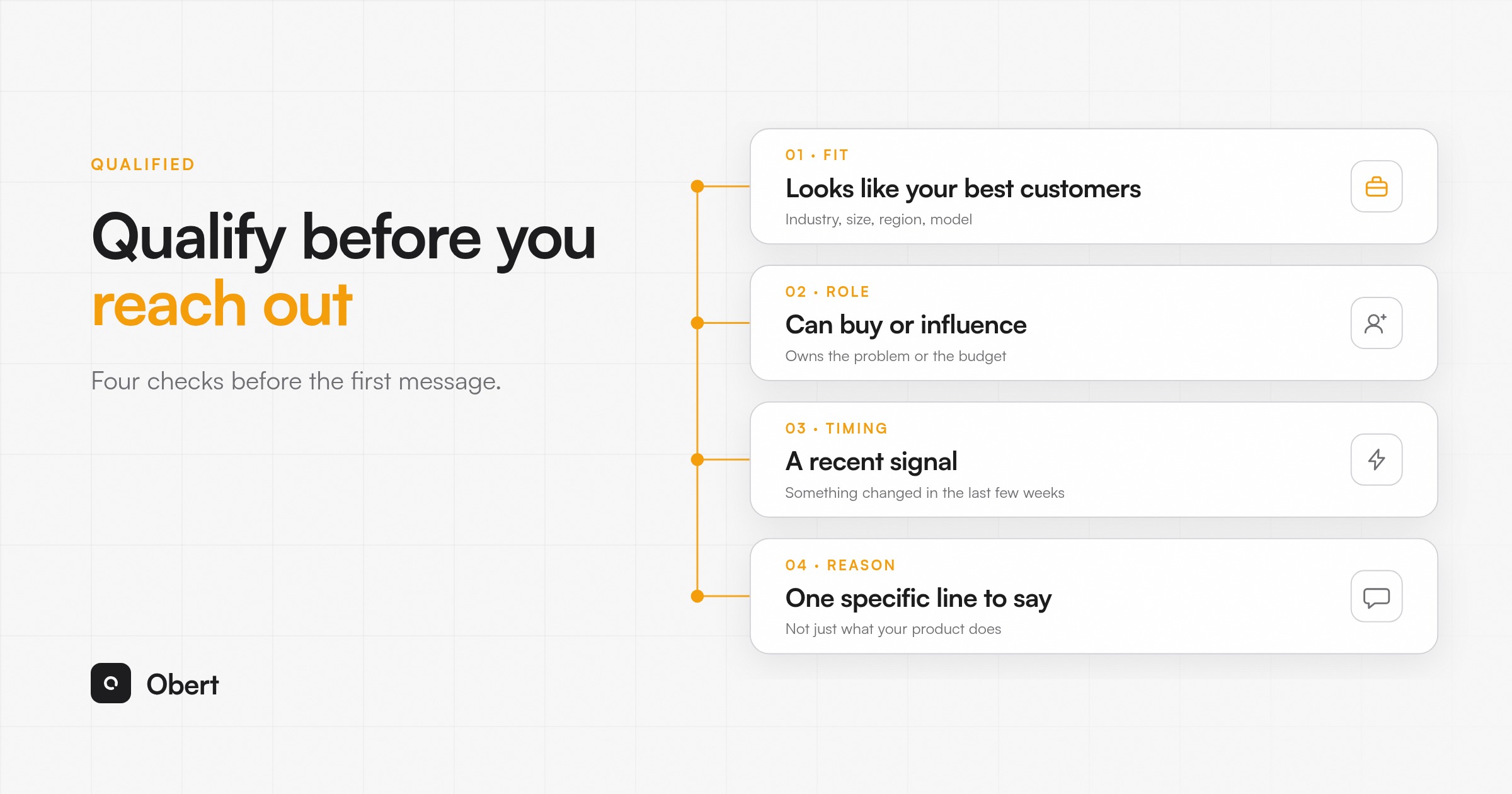
To qualify a lead before contacting them, check four things: does the company fit your best customers, can this person buy or influence the decision, is there a reason they would need it now, and do you have something specific to say. A lead that fails any of the four should not get a message yet.
Below: what qualifying a lead means, a four-part checklist, a scorecard you can copy, two worked examples, and how to do it for hundreds of leads without a research team.
What does it mean to qualify a lead?
Qualifying a lead means deciding, with evidence, whether a person is worth your team's time right now. A lead is just a name. A qualified lead is a name you have checked against what your best customers look like, with a reason to reach out this week.
The expensive way to qualify is after the fact: buy contact data, add everyone to a sequence, and learn who was a good fit from who replies. That spends data credits, sender reputation and rep time on people who were never going to buy. Checking before the first message moves the decision to the cheapest point in the process.
What should you check before contacting a lead?
1. Fit: does the company look like your best customers?
Compare the company with your best existing customers, not with a generic ideal profile. Look at industry, size, region, business model, and anything specific to your product. For a tool used by sales teams, "has a sales team of three or more people" might matter more than revenue.
Pass: matches on the traits your best customers share. Fail: wrong business model, wrong size band, or a region you don't serve.
2. Role: can this person buy or influence the decision?
The right company with the wrong person still produces no deal. Check whether the person owns the problem you solve, controls budget, or strongly influences whoever does.
Pass: decision-maker, budget holder, or a user who would champion it. Fail: no connection to the problem or the purchase.
3. Timing: is there a reason they need it now?
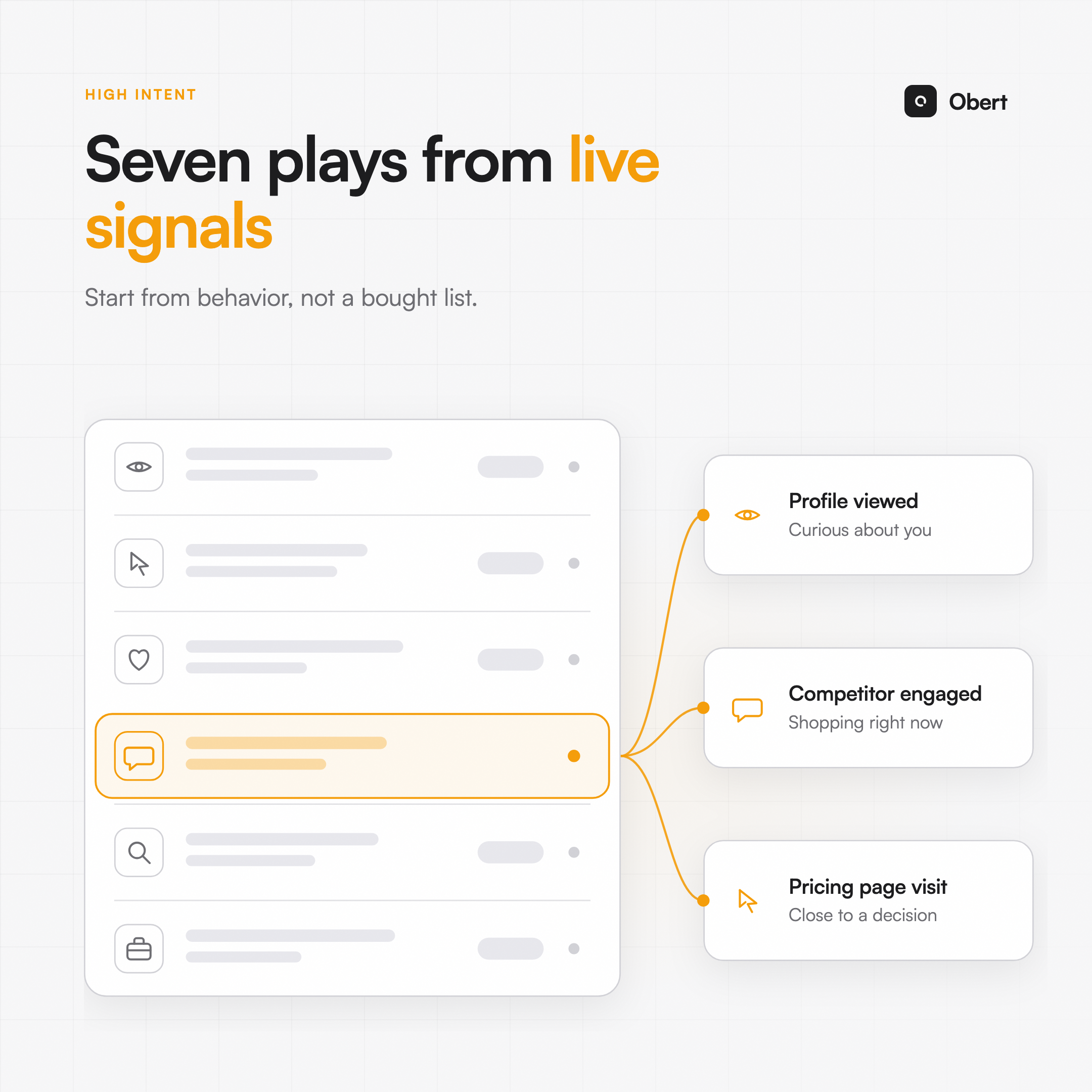
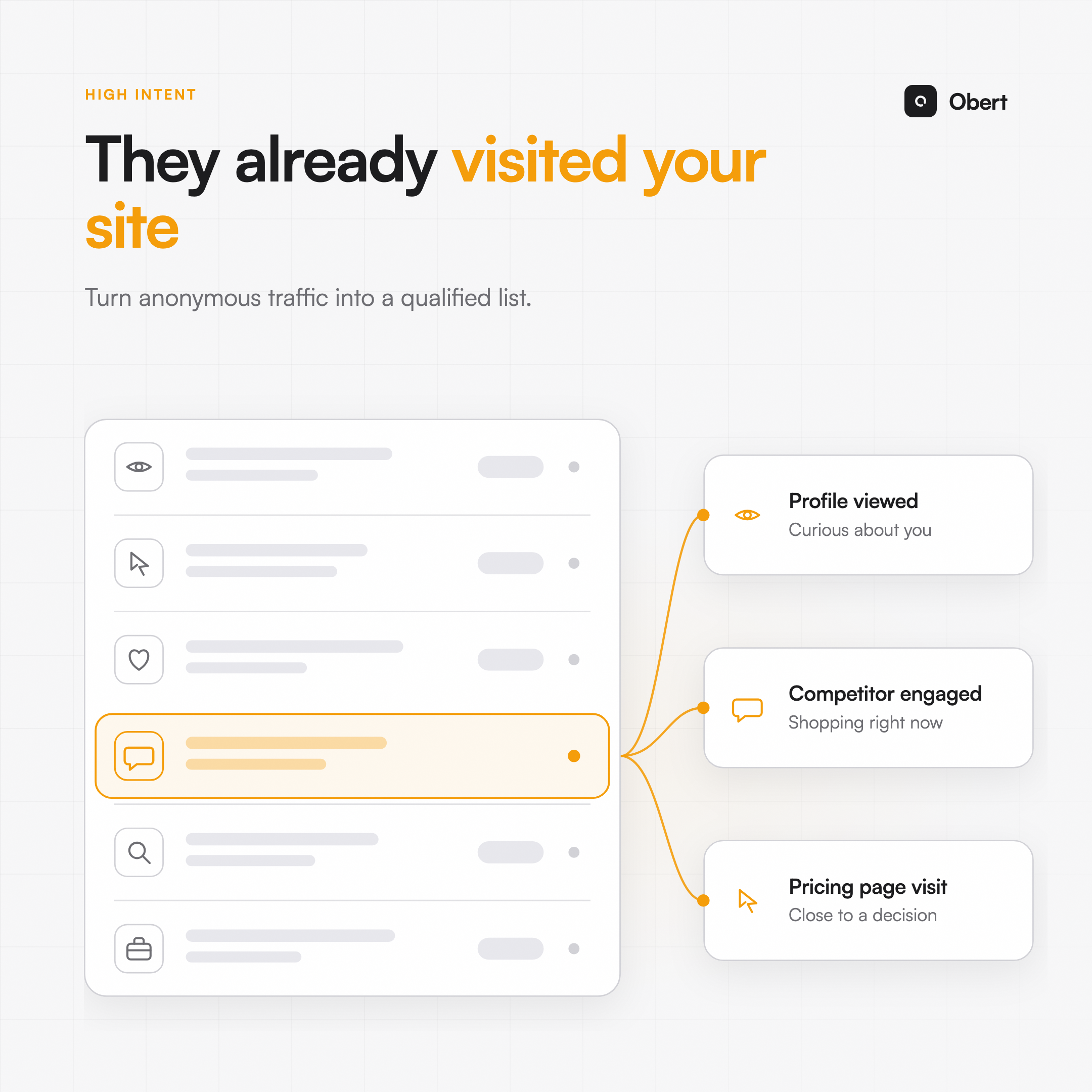
A good fit with no timing often ends in "not now". Look for something recent: hiring for roles your product supports, a new leader in the buying role, funding, repeat visits to your pricing page, or engagement with your posts or a competitor's. For ways to act on each of these, see our signal-based selling plays.
Pass: a relevant signal in the last few weeks. Fail: no signal, or a signal months old.
4. Reason: do you have something specific to say?
If you can't write one sentence about why you are contacting this person now, the message will be generic.
Pass: you can name the signal and the problem it suggests. Fail: the only thing to say is what your product does.
Lead qualification scorecard (copy this)
Score each lead before it enters a sequence. The weights below are a starting point; adjust them to what your won deals have in common.
| Check | Question | Points | Pass rule |
|---|---|---|---|
| Fit | Does the company match our best customers? | 0 to 3 | 2 or more |
| Role | Can this person buy or influence the purchase? | 0 to 3 | 2 or more |
| Timing | Is there a relevant signal from the last few weeks? | 0 to 2 | 1 or more |
| Reason | Can we write one specific sentence about why now? | 0 to 2 | 1 or more |
| Total | 0 to 10 | Contact at 7 or more, and only if every check passes |
Write down why each lead passed or failed. After a few weeks, compare those notes with who replied and who booked a meeting. That comparison is how the scorecard gets sharper.
Two worked examples
Lead A: passes (9 out of 10)
- Fit (3): B2B software company, 120 employees, sales team of eight. Matches our best customers.
- Role (3): VP of Sales. Owns pipeline and the tool budget.
- Timing (2): The company posted three SDR roles this month.
- Reason (1): "You're adding three SDRs. Keeping new reps supplied with qualified leads becomes its own job."
- Decision: contact this week.
Lead B: fails (5 out of 10)
- Fit (3): Same profile as Lead A.
- Role (1): Marketing coordinator. Not involved in sales tooling.
- Timing (1): Liked one company post four months ago.
- Reason (0): Nothing specific to say.
- Decision: don't contact. Look for the sales leader at the same company instead.
How is qualifying inbound leads different from outbound?
The four checks are the same; where the work goes changes.
| Inbound lead | Outbound lead | |
|---|---|---|
| Timing | Already shown: they came to you | Must be found: look for a signal |
| Fit | Must be checked: anyone can fill in a form | Mostly checked when the list is built |
| Role | Must be checked: the person who signs up may not be the buyer | Checked when choosing who to contact |
| Main risk | Spending sales time on a poor fit | Contacting a good fit at the wrong time |
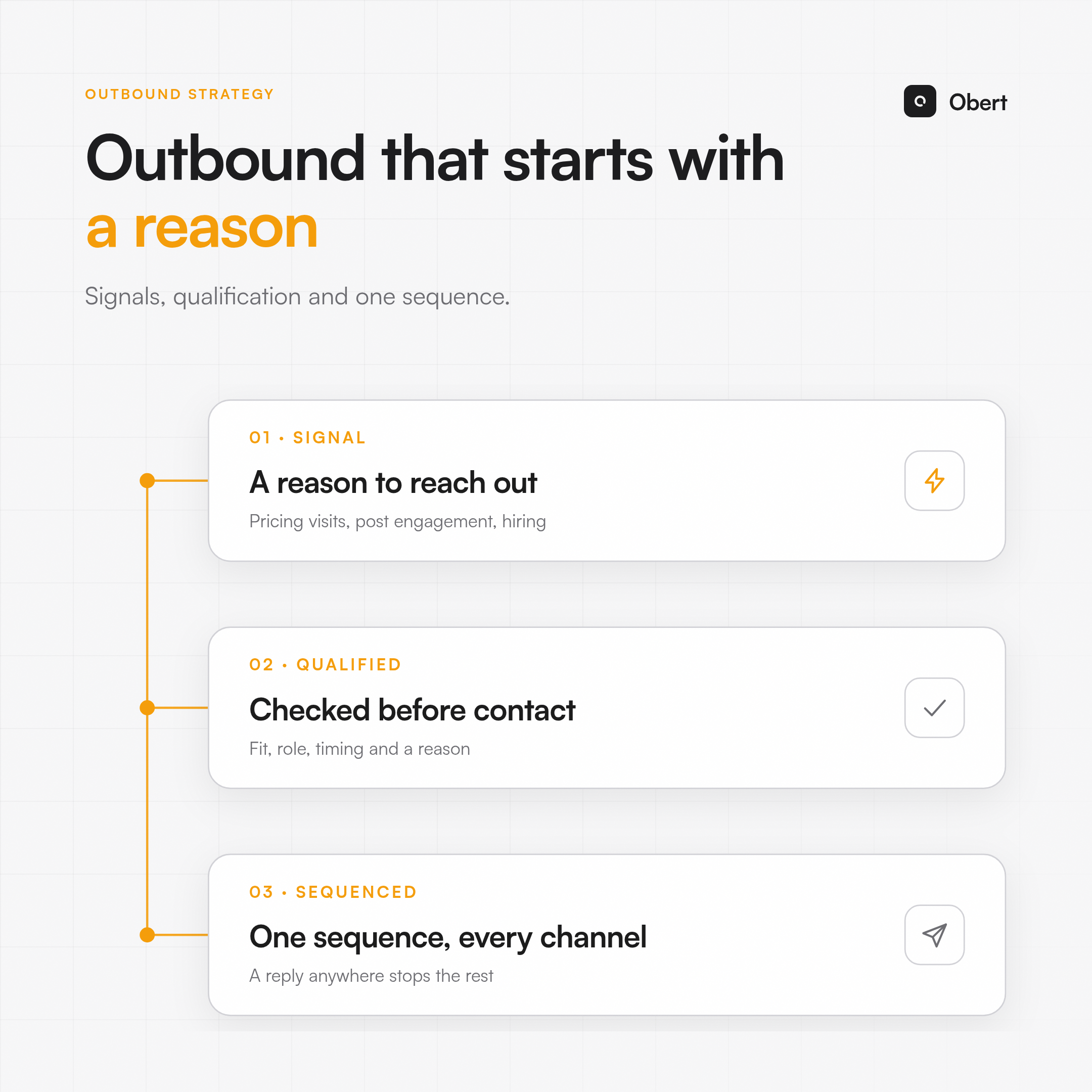
Qualification is step 3 of a full outbound sales strategy.
How do you qualify leads at scale without a research team?
Checking four things by hand is manageable for a few dozen leads a day. It doesn't hold at hundreds. Three ways to scale it:
- Write the rules down. Turn your fit and role checks into plain sentences anyone can apply the same way, and keep them in one shared place.
- Let software do the research, and people make the call. Tools can gather company and person details and check them against your rules. Look for tools that show the reasoning behind each decision, not only a score, so a rep can trust or correct it.
- Qualify before you buy data or send. Make qualification the gate that every lead passes through, whatever its source.
This is how Obert's qualification works. You write your ICP and rules once. Leads from signals, search, website visitors and imports all go through the same check, and each one gets a fit label (High Fit, Medium Fit or Unqualified) with the reasons behind it. You approve who moves to outreach.
SadehAI uses Obert's qualification agents to pick its best 20 LinkedIn invitations each day. As CEO Tamir Pariente put it: "The list was never the problem. Deciding who are the 20 gold leads was the problem." (SadehAI case study)
Where do BANT and MEDDIC fit?
BANT and MEDDIC are the best-known qualification frameworks. Both ask about things you usually learn in conversation, like budget and decision process, so they fit qualifying a deal during sales calls better than deciding who to contact in the first place.
| Framework | What it checks | Where it comes from | Best used |
|---|---|---|---|
| BANT | Budget, Authority, Need, Timeframe | Attributed to IBM (CustomerThink) | Discovery calls |
| MEDDIC | Metrics, Economic buyer, Decision criteria, Decision process, Identify pain, Champion | Created at PTC in 1996 by Dick Dunkel, working with Jack Napoli under John McMahon (MEDDICC) | Larger, multi-person deals |
| Pre-contact checklist (this guide) | Fit, Role, Timing, Reason | Obert | Before the first message |
Use the checklist to decide who hears from you. Use BANT or MEDDIC once you are talking.
Qualify every lead before it reaches a sequence
Obert is an AI outbound platform to run your GTM in one place. It checks every lead against your rules before outreach, shows the reasons, and lets your team approve who gets contacted. See how teams use it on the SDRs and AEs page, compare Obert with other tools, or check pricing. 7-day free trial, cancel anytime.
Last updated: October 10, 2026
Efi Minzer
CMO, Obert