Blog/Lean GTM craft
What is a GTM engineer? The 2026 definition
GTM engineering exists because outbound became a systems problem: one technical person now runs what a whole SDR team used to.
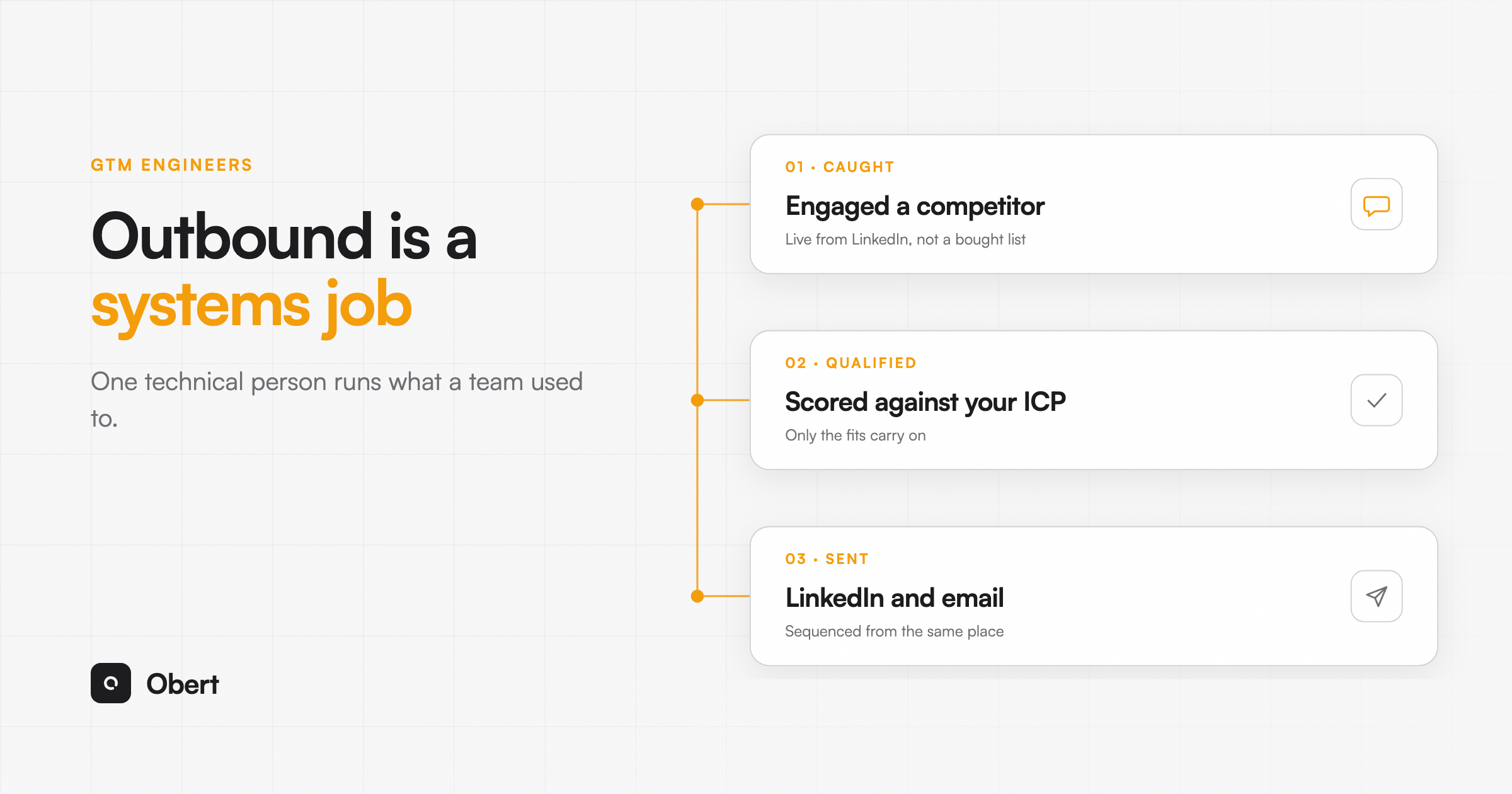
A GTM engineer is a technical person who builds and runs the systems that create pipeline: data, signals, qualification, outreach, and reporting. The role sits between sales and engineering. Instead of doing outreach by hand, a GTM engineer designs the machine that does it, then improves it with experiments. In 2026, one GTM engineer often replaces the output of a small SDR team.
Why the role exists
Outbound used to be a numbers job. More SDRs, more calls, more emails. That model broke: buyers stopped answering volume, and tools became good enough that one person could automate most of the work.
So the job changed from doing the outreach to building the system that does it. That system needs someone technical: APIs, data, automation logic, and a feel for what a good lead looks like.
Companies noticed. Job postings for GTM engineering grew 205% year over year in 2025, per Bloomberry's analysis, and the growth continued into 2026. The title barely existed three years ago; today it appears at software companies of every size, and Clay built a whole community around the identity.
What a GTM engineer actually does
The week is experiments, not quotas. A typical loop:
Find a source of leads. A signal (website visitors, competitor engagers, funding news), a list, or a database query.
Qualify them. Define what a good fit means, then build the check that filters everyone else out. In 2026 this is mostly AI agents running rules the engineer writes.
Run the outreach. Sequences on LinkedIn and email, personalized from real data. The engineer writes the logic and the fallbacks, not each message.
Measure and improve. Reply rates by segment, by signal, by message. Kill what fails, scale what works.
A real week
Here is what the calendar looks like at a company where the role works.
Monday. Review the weekend's signal catches and the qualification agents' scores. Approve the queued messages, spot-check ten scored leads to confirm the rules still hold. About two hours.
Tuesday to Wednesday. The week's experiment. Example: a new signal (people commenting on a rival's launch post), a fit rule written for it, a two-touch sequence in the AE's voice. Launched by Wednesday because nothing needs exporting between tools.
Thursday. Maintenance and requests: a new field the sales team wants synced to the CRM, a broken webhook, a rep's sequence that needs a variant.
Friday. Numbers. Reply rate by signal and by message variant, this week against last. One decision minimum: something gets killed or something gets doubled.
Notice what's absent: no hours of manual prospecting, no list cleaning marathons. When those appear, they're a sign the system needs work, not more effort.
What GTM engineers earn
Because the role is new, the numbers scatter across sources, but they cluster clearly.
The median across an analysis of more than 1,000 US job postings is $127,500 base. Total compensation typically runs from about $132,000 to $241,000, with senior and staff-level engineers at well-funded AI companies reaching $250,000 and above. Top payers in 2026 include Vercel and OpenAI at around $250,000 total.
Three things move the number most:
Technical depth. Python or SQL fluency shows up in over a third of postings and carries a significant premium; benchmark analyses put staff-level engineers with software backgrounds at a median around $200,000 base.
Company stage. AI-native and growth-stage companies pay engineering-grade salaries; seed startups start near $100,000. Location matters less than stage: remote roles at growth companies pay within a few percent of SF and NYC rates.
Scope. Builders of net-new revenue systems out-earn maintainers of existing ones, which is why the role typically pays 15 to 30% above comparable RevOps positions.
Sources vary and the market is young, so treat exact figures as snapshots, not laws.
How to become one
Here's the honest structural fact: junior GTM engineer roles barely exist. One benchmark of 235 US postings found essentially no entry-level openings; companies hire people who can already run the loop.
That makes the path self-taught by necessity, and it favors two groups.
SDRs and RevOps people going technical. You know buyers and process; add the tooling. Learn one data tool, one sending system, and enough API basics to connect things.
Technical people going commercial. You can build; add buyer judgment. Sit in on sales calls, read won-lost notes, learn what a real qualified lead looks like in your market.
Either way, the portfolio is the same: one loop, built by you, running without you. One signal, one qualification rule, one sequence, one weekly report. Ship that for your own product, a friend's company, or a job application, and you're hireable. Our playbooks show working examples you can copy.
How companies structure the role
The first hire usually reports to a founder or sales leader and owns the whole loop alone. The common mistake is treating them as a cheaper SDR and measuring them on activity; measure them on qualified conversations created per week.
At 2 to 3 people, the split is usually loop-building vs data infrastructure, or by motion (outbound vs product signals).
The tooling decision shapes the job more than the org chart. A GTM engineer gluing six tools spends most hours on integration plumbing. One running a consolidated system spends them on experiments. We wrote the full breakdown in the GTM engineer stack in 2026.
GTM engineer vs adjacent roles
vs SDR: an SDR works inside the system, sending and calling. A GTM engineer builds the system. Many SDRs are becoming GTM engineers by learning the tooling.
vs RevOps: RevOps owns the CRM, reporting, and process across the funnel. A GTM engineer owns pipeline creation specifically. Small companies often merge the two; pay data shows the builder side earns more.
vs sales engineer: a sales engineer supports deals with technical expertise during the sales cycle. A GTM engineer creates the top of the funnel. The titles get confused because both mix technical and commercial skills.
vs growth engineer: growth engineers work on the product side of acquisition (signup flows, onboarding, loops). GTM engineers work on the outbound side.
Obert is built for exactly this role: signals, agent qualification, outreach and inbox in one system, with API and MCP access. See the GTM engineers page. Try it now. 7-day free trial, cancel anytime.
Matan Kleyman
Founder, Obert
Building Obert. The LinkedIn outbound system for founders and lean GTM teams. Previously scaled outbound motions at early-stage B2B startups.